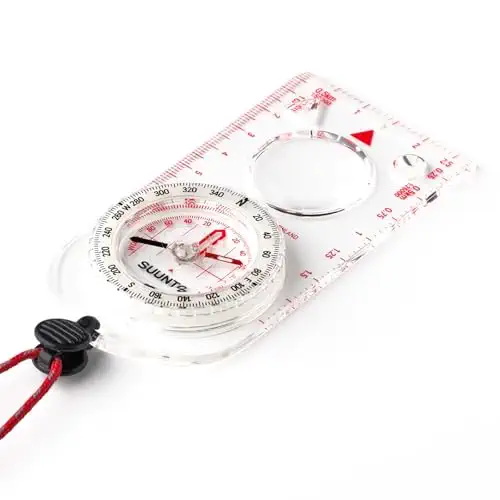
Suunto MC-2Best overall
- Type
- Sighting mirror baseplate
- Declination
- Adjustable, with tool
- Extras
- Clinometer, luminous markings
- Scales
- Metric and inch ruler
Most recommended by reviewers
Check price at Amazon
We earn a commission when you buy through our links, at no extra cost to you. How this works.
Most of us don't think about a compass until the phone is at 4% and the trail sign is gone. It's a small, cheap thing to carry, and the right one makes the difference between a quick fix and a long, cold walk. The trick is picking one that matches how you'll actually use it.
The Suunto MC-2 is our top pick: accurate, packed with useful features and loved by owners. For a lighter, cheaper option there's the Suunto A-10, and for night use or rough handling the Cammenga lensatic is hard to beat. Here's what's available right now.
1 Suunto MC-2 | 2 Suunto A-10 | 3 Silva Ranger 2.0 | 4 Cammenga 3H Tritium | 5 Suunto A-30 | |
|---|---|---|---|---|---|
| Best for | Best overall | Best budget | Best alternative sighting compass | Best for night and rugged use | Best step-up baseplate |
| Type | Sighting mirror baseplate | Baseplate | Sighting mirror baseplate | Lensatic | Baseplate |
| Extras | Clinometer, luminous markings | Not listed | Slope card, magnifier, distance lanyard | Not listed | Magnifying lens, luminescent markings |
| Made in | Finland | Finland | Not listed | USA | Not listed |
| Check price at Amazon | Check price at Amazon | Check price at Amazon | Check price at Amazon | Check price at Amazon |
Suunto MC-2Best overallMost recommended by reviewers
Check price at Amazon Suunto A-10Best budget
 Silva Ranger 2.0Best alternative sighting compass
 Cammenga 3H TritiumBest for night and rugged use
 Suunto A-30Best step-up baseplate


A full-featured mirror compass that experienced hikers keep coming back to.
Most recommended by reviewers
Check price at AmazonPrices and availability on Amazon change often.
The Suunto MC-2 is the compass we'd pick for anyone who wants precise bearings and room to grow into serious navigation.
The sighting mirror and sighting hole give more accurate bearings over long distances, and the baseplate is slightly longer to help accuracy. Adjustable declination (set with a tool) and a clinometer for slope readings round out a feature set that few picks here match. Luminous markings help in low light, it needs no batteries, and reviewers rate it very highly, with one calling it the best compass for globetrotting.
It costs noticeably more than a basic baseplate compass, and reviewers describe it as quite expensive, though they say buyers are still happy. One review also mentions the needle can occasionally stick. If you only need simple map-and-trail navigation, you may not use everything it offers.
If it's not for you, the Suunto A-10 is a light, affordable choice for beginners, while the Silva Ranger 2.0 is another sighting-mirror compass with a rubber grip.
The MC-2 is the compass most reviewers and owners point to when someone says they want one good compass for serious navigation. The sighting mirror lets you hold the compass up, line up a distant landmark and read a precise bearing, which is hard to do with a basic baseplate model.
It also has a clinometer for measuring slopes and an adjustable declination, so you can set it for where you are. It's more than a casual day hiker needs, but if you navigate off-trail, take bearings, or want a compass you'll still be happy with in a decade, it's the one.


A light, simple baseplate compass that does the basics well for very little money.
Prices and availability on Amazon change often.
For most hiking, a basic compass is plenty, and the A-10 is the one reviewers keep naming as the sensible starter. It's light, the clear baseplate works nicely on a map, and the liquid-filled capsule keeps the needle steady.
You give up a few frills: no magnifying lens, no luminous markings and a fixed declination. If you need those, step up a model. If you just want a dependable compass that won't hurt your budget, this is it.


A mirror compass with a rubber grip, built-in declination adjustment and a slope card.
Prices and availability on Amazon change often.
The Ranger 2.0 is the Silva answer to the Suunto MC-2, and reviewers rank it just behind. The rubber grip is a real plus in wet or cold hands, and the lanyard has map-distance scales built in.
It does a lot, which is great once you know your way around a compass and a bit much if you're brand new. Pick it over the MC-2 if you like the grip and the Silva layout.


A military-style lensatic compass that glows on its own and shrugs off abuse.
Prices and availability on Amazon change often.
If you navigate at night or you're hard on gear, the Cammenga is the compass owners trust. The tritium lights stay lit for years with no charging, and the case is made to be tossed in a pack.
It works differently from a baseplate compass and doesn't adjust for declination, so it's a worse fit for planning routes on a map. For pure field bearings, it's hard to beat.



The A-10 with a magnifier and luminous markings for a little extra.
Prices and availability on Amazon change often.
The A-30 costs a little more than the A-10 and adds the two things many hikers miss on the cheaper model: a magnifier and glow-in-the-dark markings. Reviewers call it a standard, very good compass for most backpacking.
If you read maps in dim light or your close-up vision isn't what it was, the upgrade is worth it.
If you mostly hike marked trails, a basic baseplate compass like the Suunto A-10 is all you need. If you read maps in low light or want a magnifier, the A-30 is the step up. For taking bearings across long distances or navigating off-trail, a sighting mirror model like the Suunto MC-2 or Silva Ranger 2.0 is worth the extra money. For night use and hard knocks, look at the Cammenga lensatic.
Sighting mirror compasses such as the Suunto MC-2 and Silva Ranger 2.0 let you take more precise bearings than basic baseplate models. Lensatic compasses like the Cammenga are also very accurate for field bearings. Larger baseplates with longer needles tend to read more accurately too.
For most hikers, a baseplate compass like the Suunto A-10 or A-30 is plenty. If you navigate off-trail or want precise bearings, the Suunto MC-2 is the pick.
Set the declination for your area if your compass allows it, lay the baseplate on your map to find a bearing, then turn the housing so the orienting arrow matches the needle. Follow the direction-of-travel arrow, and practice in easy terrain before you rely on it. Keep metal and electronics away from the compass.
A tough, simple compass you can use without a map. The Cammenga lensatic is built for rough conditions and glows without batteries, and a baseplate like the Suunto A-10 is a light backup.
A lensatic compass has a sighting wire and lens for precise bearings and is very rugged, but it's heavier and doesn't work as well with maps. A baseplate compass has a clear plate with rulers, so it works naturally with a map, and is lighter.
A liquid-filled capsule so the needle settles quickly, a clear baseplate with rulers, a rotating bezel with fine degree markings, and ideally adjustable declination. Avoid cheap compasses without a fluid-filled housing.
Why trust CheckedBest
This shortlist is built from five Amazon listings compared side by side, each confirmed in stock, and weighed against what reviewers and owners in hiking and backpacking communities say about accuracy, durability and ease of use. Every compass here works without batteries.
Our expert team tests products when it is needed and researches online and in interviews. Every guide is fact-checked and edited by a real person.
The CheckedBest editorial team · Updated Oct 28, 2026
How we pickEditorial standardsAffiliate disclosureReport a mistake
We earn a commission when you buy through our links, at no extra cost to you. It never decides the winner.