 Thermal Master T2 ProBest overall
- Lens
- 13mm
- Resolution
- 256 x 192
- Max detection range
- 769 yards (7 ft target)
- Zoom
- 15x digital
Most recommended by reviewers
Check price at Amazon
We earn a commission when you buy through our links, at no extra cost to you. How this works.
If you want to watch deer, coyotes or other animals after dark without disturbing them, a thermal monocular lets you see their heat signature through brush and in total darkness. The best thermal camera for wildlife is the Thermal Master T2 Pro. It detects a deer-sized target at very long range and has a phone-based display that is easy to share.
The other two picks cover a budget option and a pocket-sized design. Pick by how far you need to see and how much you want to spend.
1 Thermal Master T2 Pro | 2 GOYOJO G215 | 3 RIX Pocket K2 | |
|---|---|---|---|
| Best for | Best overall | Best budget | Most portable |
| Lens | 13mm | 15mm | Not listed |
| Resolution | 256 x 192 | 256 x 192 (50Hz) | Not listed |
| Zoom | 15x digital | 4x | Not listed |
| Connection | iPhone app | Not listed | Wi-Fi |
| Check price at Amazon | Check price at Amazon | Check price at Amazon |
Thermal Master T2 ProBest overallMost recommended by reviewers
Check price at Amazon GOYOJO G215Best budget
 RIX Pocket K2Most portable



A long-range thermal monocular that connects to your iPhone, aimed at hunters and wildlife watchers.
Most recommended by reviewers
Check price at AmazonPrices and availability on Amazon change often.
The Thermal Master T2 Pro is our top pick for wildlife watching, and it earns that spot on sheer reach: it is rated to detect a 7 ft target from over 769 yards.
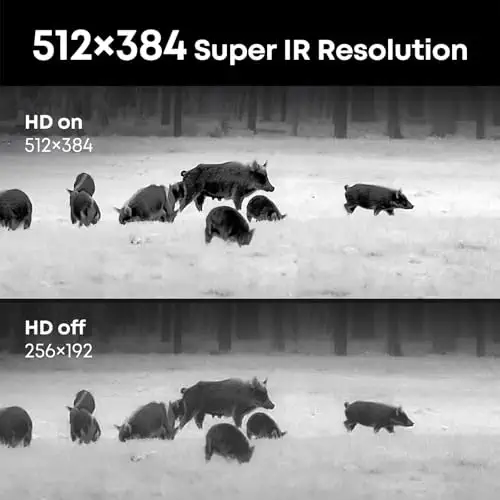
The 13mm lens and 256 x 192 sensor give it the longest stated detection range of the three picks, and the listing puts whitetail deer at 700 yards and coyotes at 300 yards. Its ninja mode dims the phone screen to the lowest level so animals are less likely to notice you at night. The hotspot tracking function follows fast-moving animals, which helps in fog as well as darkness.
The T2 Pro has no standalone screen, so you need to pair an iPhone to view anything. If you want a device that works on its own, the GOYOJO G215 is a better fit, since it runs without a phone and has replaceable batteries.
If it's not for you, the GOYOJO G215 suits anyone who wants a standalone monocular at a lower price, and the RIX Pocket K2 suits hikers who want something lighter than a smartphone.
The T2 Pro reaches far further than most monoculars at this price, which matters when you are watching animals across a field. The 13mm lens and 256 x 192 sensor give enough detail to tell an animal from its surroundings.
The ninja mode is useful for observing animals close up at night without the screen giving you away.


A standalone thermal monocular with a built-in screen and a 4x zoom, for a lower price.
Prices and availability on Amazon change often.
The G215 is the cheapest way to get a standalone thermal monocular at this resolution. Its 15mm lens and 4x zoom are enough for watching nearby wildlife in a yard or on a trail.
The replaceable batteries mean you can keep a spare and avoid running out mid-watch.


A pocket-sized thermal monocular with an OLED display and image stabilisation.
Prices and availability on Amazon change often.
The Pocket K2 is the easiest to carry on a hike and still has a sharp display. The stabilisation helps when you are watching at a distance without a tripod.
It suits people who want to keep a thermal camera in a jacket pocket rather than a bag.
Check the detection range and whether the listing states species identification range separately. Battery life, weatherproofing and ergonomics matter for long sessions outdoors.
A thermal camera shows heat emitted by objects, so it works in total darkness. An infrared camera usually needs an illuminator to see at night.
The Thermal Master T2 Pro is the strongest overall pick, detecting a deer-sized target at up to 769 yards.
The GOYOJO G215 is the cheapest standalone thermal monocular here, with a built-in screen and 4x zoom.
For a standalone device, the GOYOJO G215; for long range using your phone, the T2 Pro.
Check the detection range, sensor resolution, battery life and weatherproofing before you buy.
Thermal cameras detect heat, so they work in total darkness. Infrared cameras usually need a light source.
Thermal imaging describes the technology; FLIR is one brand that makes thermal cameras. This shortlist covers several brands.
Why trust CheckedBest
This shortlist is built from three in-stock Amazon listings, weighed on detection range, sensor resolution, battery life and weather sealing. Expert and community guidance on matching a device to your terrain and species was used to shape the picks.
Our expert team tests products when it is needed and researches online and in interviews. Every guide is fact-checked and edited by a real person.
The CheckedBest editorial team · Updated Nov 10, 2026
How we pickEditorial standardsAffiliate disclosureReport a mistake
We earn a commission when you buy through our links, at no extra cost to you. It never decides the winner.
