 Vortex Crossfire HD 20-60x80Best overall
- Magnification
- 20-60x
- Objective lens
- 80mm
- Body
- Angled
- Mount
- Arca-Swiss compatible foot
Most recommended by reviewers
Check price at Amazon
We earn a commission when you buy through our links, at no extra cost to you. How this works.
A spotting scope earns its keep the moment something interesting is too far away for binoculars: a bull elk on a far ridge, a bullet hole at 300 yards, a hawk on a distant snag. Owners keep saying the same two things, though. Glass quality matters more as the zoom goes up, and a sturdy tripod matters as much as the scope.
Our top pick is the Vortex Crossfire HD 20-60x80, an HD-glass scope with a lifetime warranty that owners keep coming back to. Below it are a cheaper starter scope, a big-aperture option for low light, a travel-friendly compact and a premium splurge.
1 Vortex Crossfire HD 20-60x80 | 2 Gosky 20-60x80 | 3 Vortex Diamondback HD 20-60x85 | 4 Vortex Crossfire HD 12-36x50 | 5 Vortex Razor HD 27-60x85 | |
|---|---|---|---|---|---|
| Best for | Best overall | Best budget | Best for low light and big game | Best compact | Best premium upgrade |
| Magnification | 20-60x | 20-60x | 20-60x | 12-36x | 27-60x |
| Objective lens | 80mm | 80mm | 85mm | 50mm | 85mm |
| Body | Angled | Not listed | Angled | Angled | Not listed |
| Mount | Arca-Swiss compatible foot | Not listed | Arca-Swiss compatible | Arca-Swiss compatible foot | Not listed |
| Check price at Amazon | Check price at Amazon | Check price at Amazon | Check price at Amazon | Check price at Amazon |
Vortex Crossfire HD 20-60x80Best overallMost recommended by reviewers
Check price at Amazon Gosky 20-60x80Best budget
 Vortex Diamondback HD 20-60x85Best for low light and big game
 Vortex Crossfire HD 12-36x50Best compact
 Vortex Razor HD 27-60x85Best premium upgrade


HD glass, a wide zoom range and a lifetime warranty at a mid-range price.
Most recommended by reviewers
Check price at AmazonPrices and availability on Amazon change often.
The Vortex Crossfire HD 20-60x80 is the spotting scope we'd pick for most people, pairing HD glass and a big lens with a lifetime warranty.
The HD optical system is built to cut chromatic aberration and deliver truer color than basic scopes, and the 80mm objective gathers plenty of light in dim conditions. The Arca-Swiss compatible foot mounts straight onto most tripods, so setup is simple. It's also waterproof, fogproof and rubber armored, and the lifetime warranty is one owners repeatedly praise. Owners on r/longrange report that the Vortex spotting scope is adequate for casual range spotting, with one saying it works out to 500 yards just fine.
At the top of the zoom range the image softens, which is true of any scope at this price. You'll get the crispest view by staying a bit below 60x and letting the 80mm lens do the work.
If it's not for you, the Gosky 20-60x80 suits anyone on a tight budget who wants a tripod and phone adapter included, while the Vortex Crossfire HD 12-36x50 is the one for carrying all day.
This is the scope we would point most people toward. It pairs a big 80mm lens with HD glass and a helical focus, so it gathers plenty of light and focuses quickly and finely. The angled body is comfortable for long sessions on a tripod.
What keeps owners loyal is the warranty. Hunters and shooters say they pick Vortex mainly because a damaged scope gets repaired or replaced, which takes much of the risk out of buying at this price.


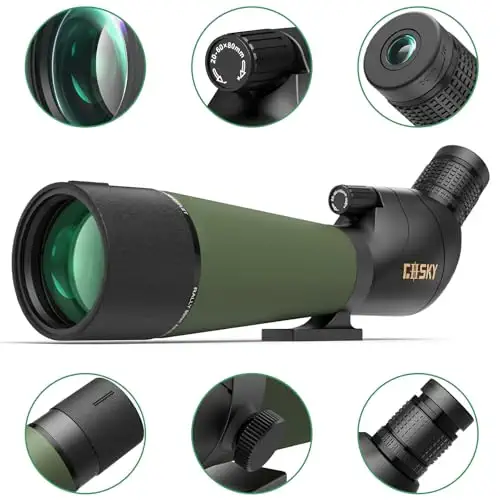

A big 80mm lens and a full accessory kit for well under what branded scopes cost.
Prices and availability on Amazon change often.
If you want a scope for backyard birding, camping or checking targets inside about 200 yards, this kit gives you nearly everything in the box. Budget scopes in this class tend to do fine at modest range and fall off when you push the zoom, so keep expectations realistic.
Plan to add a proper tripod if you use it above 25x. Vibration hurts the view more than the glass does.


An 85mm HD scope built for glassing at dawn and dusk.
Prices and availability on Amazon change often.
This is the scope for people who glass for animals in the last light of the day. The larger lens and HD glass give a brighter, cleaner picture than the older non-HD Diamondback, which owners say looks soft over 40x.
One owner used it to pick out wolves several miles away across a valley. Expect a heavier pack, so pair it with a solid tripod.


A small, light scope that fits a backpack and keeps the lifetime warranty.
Prices and availability on Amazon change often.
Not every trip needs an 80mm tube. If you hike or hunt and the scope often gets left at the truck because it is too bulky, a 50mm scope is easier to justify carrying. Owners call this one a great spotter for the money.
Choose it for daylight viewing and moderate distances, and choose a bigger scope if you need to glass deep into shadows.


High-end triplet apochromatic glass that owners compare to scopes costing far more.
Prices and availability on Amazon change often.
If you glass a lot and want serious glass without paying for the top-tier European brands, this is the step up.
It is overkill for casual use, but for hunters and long-range shooters who live behind a scope, the extra clarity is easy to notice.
Start with the lens size: 50 to 65mm is easiest to carry, 80 to 85mm is brighter in low light. Look for HD or extra-low-dispersion glass if you want clean color at high zoom. Check that the scope is waterproof and fogproof, and that the foot fits your tripod. Then set aside part of your budget for a good tripod, because owners say vibration hurts the view more than the optics do.
Owners most often point to Vortex for the warranty and the HD line, and to Athlon and Gosky for lower budgets.
Owners rate both well. Vortex wins on warranty and widely available HD models; Leupold SX-2 and SX-4 scopes are praised for clarity and adjustments at a similar price. Handle both if you can before buying.
For general hunting, an angled 65 to 85mm scope with HD glass is the usual advice. Choose 65mm if weight matters and 80 to 85mm if you glass a lot at dawn and dusk.
Birders favor angled scopes with a comfortable eyecup, a sturdy tripod and, for digiscoping, a good phone adapter. Practice on a still object at typical birding distance to learn the focus and zoom.
Most owners use 20x to 60x. At long range, heat shimmer and moisture limit the image as much as the glass, and higher magnification also magnifies imperfections, so quality glass matters more as you zoom.
Shooters recommend a sturdy tripod, good glass and realistic expectations. Budget scopes work to roughly 200 to 300 yards, while seeing small bullet holes much farther away generally takes better optics or a spotting binocular.
Why trust CheckedBest
This shortlist is built from the listings of five spotting scopes that are available right now. We compared aperture, magnification, glass, weight, accessories and warranty, and weighed them against what owners say in shooting, hunting and birding communities.
Our expert team tests products when it is needed and researches online and in interviews. Every guide is fact-checked and edited by a real person.
The CheckedBest editorial team · Updated Oct 26, 2026
How we pickEditorial standardsAffiliate disclosureReport a mistake
We earn a commission when you buy through our links, at no extra cost to you. It never decides the winner.


