 Blue Deer F2H PROBest overall
- Weight
- 1.06 oz
- Battery
- 8-10 hours
- Water rating
- IPX5
- Connectivity
- Bluetooth 5.3
Most recommended by reviewers
Check price at Amazon

Reviewed by
Fact-checker and content editor
Experienced researcher and AI content editor, having worked on various merchant websites.
We earn a commission when you buy through our links, at no extra cost to you. How this works.
Bone conduction hearing aids send sound through the cheekbones to the inner ear, so the ear canal stays open. That makes them a fit for people with mild to moderate hearing loss who want to hear conversation and TV more clearly without something sealed in the ear.
Our top pick is the Blue Deer F2H PRO, which combines bone conduction with a companion app, per-ear volume control and noise-canceling-style modes. The other picks cover a lighter, simpler device, a budget option and a unit with strong English speech tuning and a US support line.
1 Blue Deer F2H PRO | 2 AHA B-1 | 3 mocodi Bone Conduction Amplifier | |
|---|---|---|---|
| Best for | Best overall | Best for US-based support | Best budget |
| Weight | 1.06 oz | Not stated in listing | 0.8 oz |
| Battery | 8-10 hours | Up to 10 hours | Up to 9 hours |
| Water rating | IPX5 | Not listed | IP67 (per title); sweatproof (per features) |
| Connectivity | Bluetooth 5.3 | Not listed | Bluetooth, with listening mode |
| Check price at Amazon | Check price at Amazon | Check price at Amazon |
Blue Deer F2H PROBest overallMost recommended by reviewers
Check price at Amazon AHA B-1Best for US-based support
 mocodi Bone Conduction AmplifierBest budget


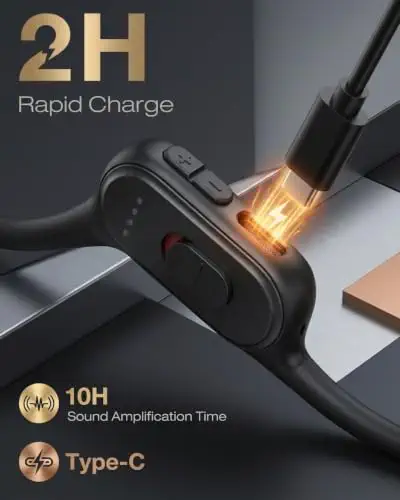

A feature-rich open-ear amplifier with per-ear volume and an app for adjusting sound.
Most recommended by reviewers
Check price at AmazonPrices and availability on Amazon change often.
The Blue Deer F2H PRO is our pick for most people shopping for a bone conduction hearing aid, because it pairs comfort with the most personal control of the group.
At 1.06 oz, the F2H PRO is light enough for all-day wear, and its 8 to 10 hour battery matches a full day of use. The standout feature is that each earpiece has its own volume, so you can compensate for one ear hearing better than the other, and a five-level memory remembers your setting each time you put it on. A companion app lets you adjust sound effects and check battery status, and the IPX5 rating covers sweat and light rain.
It costs more than most other picks in this guide, so it's a real step up in price. If you'd rather not pay for app controls, the AHA B-1 gives you independent ear volume with physical buttons and a US-based support line. If it's not for you, the mocodi suits buyers who want the lowest price and a feather-light frame.
If it's not for you, the AHA B-1 suits buyers who want US-based phone support and a 1-year warranty without needing an app, and the mocodi suits budget buyers who want the lightest, lowest-priced option.


Tuned for English speech, with physical controls and a US phone line for support.
Prices and availability on Amazon change often.


A lightweight, low-cost open-ear amplifier with Bluetooth and a 9-hour battery.
Prices and availability on Amazon change often.


A featherlight amplifier with simple buttons, indoor, outdoor and voice modes, and IPX5 splash protection.
Prices and availability on Amazon change often.
Bone conduction devices send sound through the cheekbones and leave the ear canal open. They suit people who want clearer conversation and TV without something sealed in the ear. Owners on discussion boards report that they work well for some hearing losses and less well for others.
Owners say bone conduction works better for some causes of hearing loss than others. One owner found a bone conduction device worse for their loss and preferred in-ear noise-canceling headphones. If your hearing loss is significant, speak with an audiologist before buying.
The Blue Deer F2H PRO is our top pick for its app and per-ear volume control. The AHA B-1 suits people who want physical controls and US phone support, and the mocodi unit is the budget option.
Owners report they work well for some people and less well for others. Effectiveness depends on the cause of hearing loss, so check with an audiologist first.
Bone conduction sends sound as vibrations through the cheekbones to the inner ear, bypassing the outer ear canal. Because the ear stays open, you can still hear the room around you.
They can help some people hear conversation more clearly, but owners report mixed results. One owner said they did not help their hearing loss at all.
The sources we read do not show that bone conduction devices treat tinnitus. Speak with a doctor or audiologist about tinnitus.
A BAHA is a surgically fitted bone-anchored hearing system, which is a different product from the external devices on this page.
Meet the reviewer
Fact-checker and content editor
Experienced researcher and AI content editor, having worked on various merchant websites. Experience in AI transcription, prompt engineering and taxonomy mapping for search engines.
Why trust CheckedBest
The shortlist is built from four Amazon listings that are in stock now, checked against owner discussions and the one editorial review that covers this category. Every spec and claim is taken from the listing or a cited source.
Our expert team tests products when it is needed and researches online and in interviews. Every guide is fact-checked and edited by a real person.
The CheckedBest editorial team · Updated Nov 7, 2026
How we pickEditorial standardsAffiliate disclosureReport a mistake
We earn a commission when you buy through our links, at no extra cost to you. It never decides the winner.
